Kyle Murphy
Static vs Dynamic Websites: Choosing the Right Tool for the Job
Static or dynamic website? A plain-English look at the pros and cons of each, from hosting cost and security to editing, plugins and maintenance.
- websites
- hosting
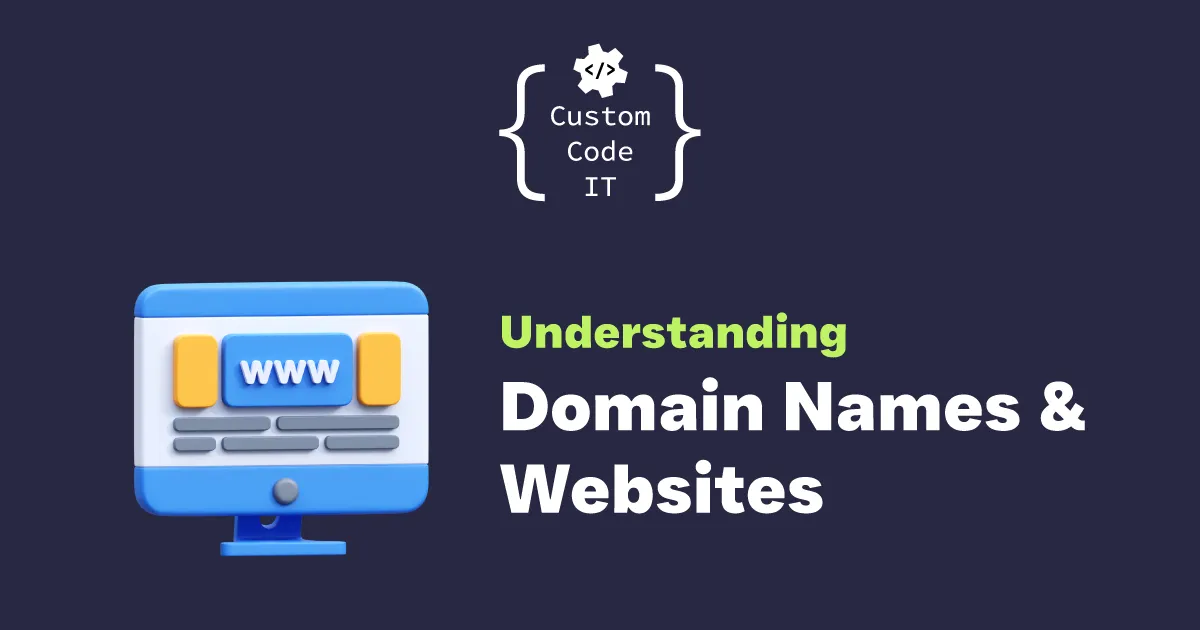
When you research how to build a new website, you inevitably run into talk about domain names. You probably wonder what they are, what they have to do with a website, and why you need one.
You may never need to understand them deeply, because hosting providers do a solid job of taking care of this for you. Still, it helps to understand what it means to buy a domain name and how it relates to hosting your website.
This is a high-level overview of the basic concept and how it relates to websites. It skips the tedious detail.
At its most basic, a domain name is a unique set of characters that identifies services you own and control on a network. Here, the network is the internet.
You will most commonly see a domain name that reflects the name of a business or service, but it can be any set of characters.
Examples of domain names are:
Here's a quick exercise. List the people you know, in your head. It's pretty easy to name a whole bunch of them, right?
Now list those people's phone numbers. That's considerably harder.
It's much easier to commit a name to memory than a number, so think of a domain name as an entry in a phone book. You don't have to know a person's phone number. You look up their name, and your phone handles the rest.
Behind the scenes, a domain name resolves to an IP address, which identifies a device on a network (in simple terms). Examples of IP addresses are:
In short, it's much easier to tell someone "Just go to google.com" than "Just go to 142.251.46.174 or 2607:f8b0:4005:80c::200e".
To buy and register a domain name, you go through a domain registrar.
A domain registrar leases you a domain and typically also offers tools for linking IP addresses to domain names, and often more.
Some good domain registrars are:
There are many to choose from, and they differ in price, features and services. There is typically no lock-in, and you can move your domain names between registrars as needed. We cover where to buy in our post on business email.
A website is nothing more than some code that lives on a server (essentially a computer) somewhere in the world. That server has an IP address, which is hard to remember.
Going back to the phone book example, it's much easier to tell everyone about your website with an easy-to-remember name than with a jumble of numbers.
By pointing your domain name at the IP address of the server your website lives on, you no longer need to remember the IP address.
Just like phone numbers, IP addresses can change. Imagine the headache of telling everyone on the internet that the IP address of your website has changed.
This is a very high-level overview of what is otherwise quite a complicated topic. If it interests you, I would recommend digging deeper to understand some of the concepts at a more fundamental level.
If you need IT support, a website or software, get in touch.
Kyle Murphy
Static or dynamic website? A plain-English look at the pros and cons of each, from hosting cost and security to editing, plugins and maintenance.
Kyle Murphy
Content ideas for a small business website: testimonials, image galleries, project portfolios, staff profiles, client interviews and a blog.
Kyle Murphy
Stock images make a website feel generic. Why to avoid them, what to use instead and the few times they make sense.
Take a moment to celebrate, give that scrolling finger a break, then contact us because we'd love to hear from you.
0466 624 345